

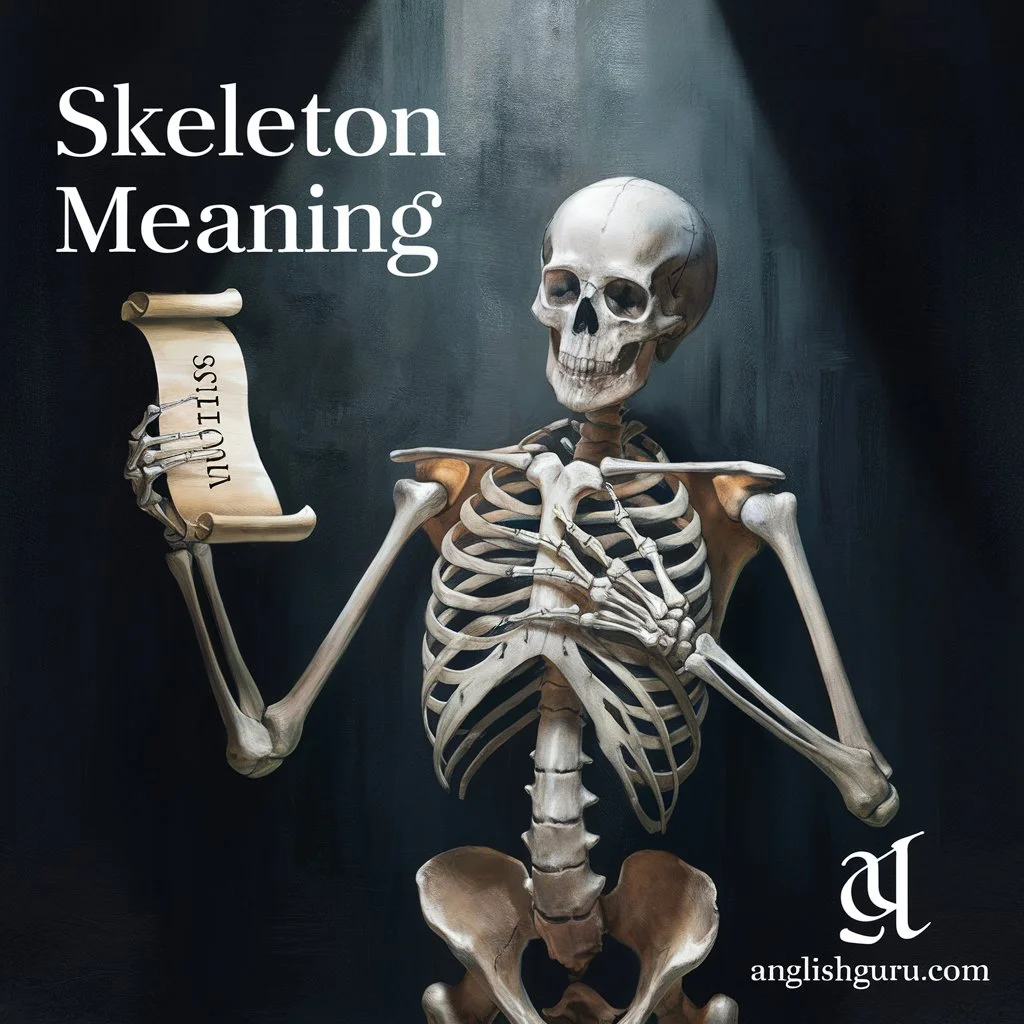
The word skeleton is widely used across biology, medicine, education, design, literature, slang, and everyday language. Many users search for “18+ skeleton meaning” to understand its literal definition, symbolic meanings, modern slang usage, and contextual interpretations.
In this in-depth guide, we will explore 18+ meanings and contexts of skeleton, its origin, tone variations, formal vs casual usage, and 11+ real-life examples. This article is written with user intent, clarity, SEO readability, and Yoast-style structure in mind.
What Does Skeleton Mean?
At its core, the skeleton refers to the framework of bones that supports a human or animal body. However, beyond anatomy, the elephant also carries symbolic, structural, and metaphorical meanings.
Basic Definitions:
- Skeleton = Bone framework / Structural outline / Minimal framework
- Part of Speech: Noun
- Tone: Neutral, scientific, symbolic, or informal
Example:
“The human skeleton consists of 206 bones.”
Origin and History of Skeleton
The word skeleton originates from the Greek word skeletos, meaning dried-up body or mummy. It entered English in the 16th century, initially used in medical and anatomical studies.
Over time, skthe eleton expanded to include:
- Structural outlines (plans, frameworks)
- Hidden secrets (figurative use)
- Minimal staffing or resources
Today, skeleton is used both literally and metaphorically across many fields.
Why Understanding Skeleton Matters
Understanding skthe eleton helps you:
- Grasp scientific and medical concepts
- Interpret metaphorical language in media and literature
- Understand professional terms like “skeleton staff” or “skeleton plan”
- Avoid confusion between literal and figurative meanings
Correct understanding ensures clarity across academic, professional, and casual contexts.
18+ Meanings and Contexts of Skeleton
Below are 18+ meanings and uses of the word skeleton.
1. Human Bone Structure
The framework of bones in the human body.
Example: “The skeleton protects vital organs.”
2. Animal Skeleton
Bone structure of animals.
Example: “The museum displayed a dinosaur skeleton.”
3. Medical Anatomy
Used in biology and medicine.
Example: “Doctors studied the skeletal system.”
4. Educational Term
Used in textbooks and classrooms.
Example: “Students learned about the skeleton.”
5. Structural Framework
Basic structure of something.
Example: “This document is only a skeleton outline.”
6. Skeleton Plan
A rough or basic plan.
Example: “They created a skeleton plan for the project.”
7. Skeleton Staff
Minimum number of workers.
Example: “The office ran on a skeleton staff.”
8. Figurative Secret (Skeleton in the Closet)
Hidden shame or secret.
Example: “Everyone has skeletons in the closet.”
9. Literary Symbolism
Symbol of death or mortality.
Example: “The skeleton symbolized the passage of time.”
10. Horror & Pop Culture
Used in movies, games, and art.
Example: “Skeleton characters appear in horror films.”
11. Fashion & Design
Skeleton prints or motifs.
Example: “Skeleton-themed clothing is trending.”
12. Minimal Framework
Bare minimum version.
Example: “The proposal is still a skeleton.”
13. Archaeology
Refers to ancient remains.
Example: “Archaeologists uncovered a human skeleton.”
14. Religious or Spiritual Symbol
Symbol of death and rebirth.
Example: “Skeletons appear in Day of the Dead traditions.”
15. Gaming Term
Skeleton enemies or characters.
Example: “Skeleton warriors appear in RPG games.”
16. Animation & Art
Used in character rigging.
Example: “Artists design skeleton rigs for animation.”
17. Technical Documentation
Basic outline of code or systems.
Example: “This file is just a skeleton framework.”
18. Social Commentary
Used metaphorically for emptiness.
Example: “The city felt like a skeleton after dark.”
19. Metaphorical Weakness
Lack of substance.
Example: “The argument was only a skeleton of an idea.”
Formal vs Casual Usage of Skeleton
Formal Usage
Used in:
- Medical and scientific writing
- Academic papers
- Professional planning
Example:
“The skeleton provides structural support to the body.”
Casual Usage
Used in:
- Everyday conversation
- Slang or idioms
- Media and pop culture
Example:
“We’re working with a skeleton crew today.”
Correct Placement of Skeleton in a Sentence
Skeleton is usually placed:
- As a noun
- Before another noun (adjective use)
Correct:
“They prepared a skeleton outline.”
Incorrect:
“They outline skeleton prepared.”
11+ Real-Life Examples of Skeleton
- “The doctor explained how the skeleton supports the body.”
- “The museum displayed a dinosaur skeleton.”
- “We are operating with a skeleton staff today.”
- “She shared the skeleton of her business idea.”
- “Everyone has skeletons in the closet.”
- “The horror movie featured animated skeletons.”
- “The project proposal is still a skeleton.”
- “Artists use skeleton rigs in animation.”
- “The classroom had a plastic skeleton model.”
- “The town felt like a skeleton after the festival.”
- “The codebase is just a skeleton framework.”
- “Skeleton patterns are popular in street fashion.”
Common Mistakes to Avoid
- Confusing literal and figurative meanings
- Overusing skeleton metaphors in formal writing
- Assuming skeleton only means bones
- Misusing idioms like “skeleton in the closet”
Tips for Using Skeleton Effectively
- Match usage with context (medical vs metaphorical)
- Use figurative meanings carefully in professional writing
- Clarify methe aning ifin case theudience may misunderstand
- Avoid overuse in serious documents
- Leverage symbolism in creative writing
Why Understanding Skeleton Matters Today
- Enhances comprehension in education and science
- Improves interpretation of idioms and metaphors
- Helps in professional planning and documentation
- Supports creative expression in media and art
- BrBridges”iteral and symbolic language use
Conclusion
The word skeleton carries 18+ meanings and contexts, ranging from human anatomy and science to symbolism, planning, slang, and pop culture. Understanding the skeleton allows you to communicate clearly across academic, professional, and casual environments.
Whether referring to bones, plans, secrets, or minimal frameworks, mastering the use of skeleton ensures precision, clarity, and contextual accuracy.